Latest News
What are the types of emergency lights
Release time:2024-10-21 13:10
There are various types of emergency lights, which can be classified into the following types according to different classification criteria:
Classification according to the working status of emergency lights
maintained emergency lights: continuous emergency lightsThis type of emergency light is capable of providing continuous illumination, unaffected by the failure of the normal lighting power supply. It is always maintained in working condition to ensure that adequate lighting is provided at all times.
 |
 |
non maintained emergency lights: non maintained emergency lights provide light only when the normal lighting power supply fails. They are usually on standby and will automatically activate and provide emergency lighting when a power failure is detected.
 |
 |
Composite emergency lights: Composite emergency lights contain two or more light sources, at least one of which can provide illumination in the event of a normal lighting power failure. This kind of emergency light has higher reliability and flexibility.
 |
Specifically, you can click on the text inside the brackets, the previous blog post has a specific introduction (about what is maintained emergency lights and Non maintained emergency lights)
Classification of emergency lights by function
Emergency lights lighting fixture type: Illuminated emergency lights provide essential lighting to walkways, exit routes, stairways and potentially hazardous areas in the event of an accident. They ensure that in an emergency, people can clearly see their surroundings and thus find a safe evacuation path.
 |
 |
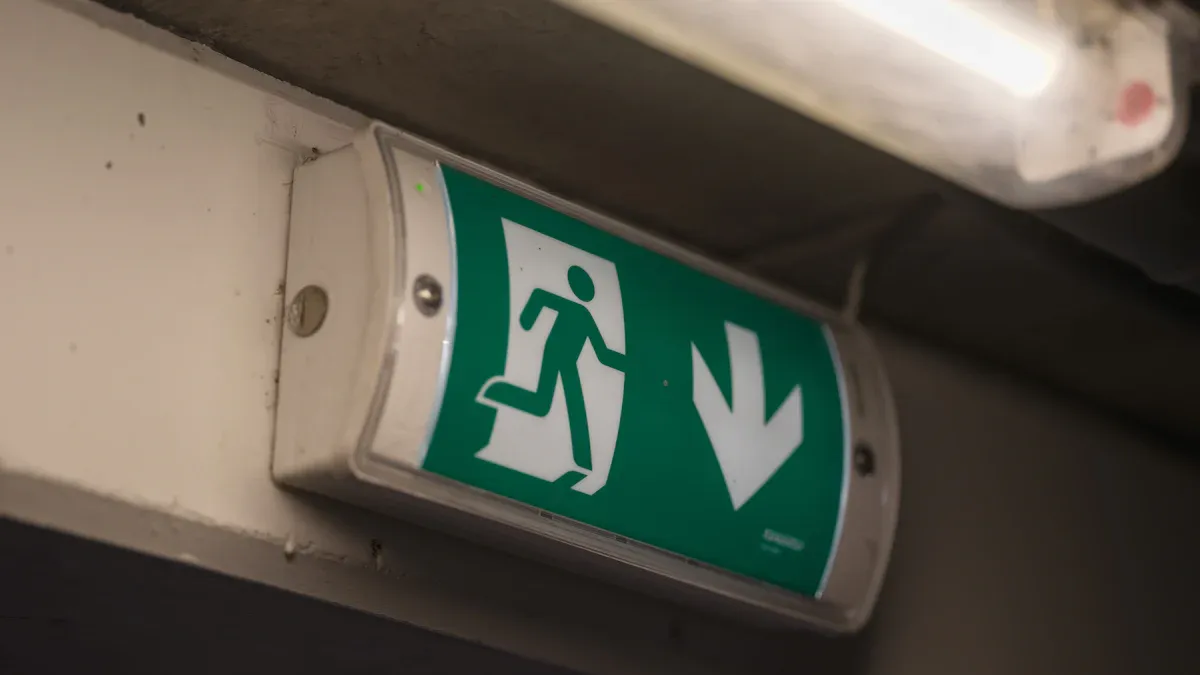
mergency lights sign type: Sign type emergency lights provide a clear indication of the direction of exits and passageways. They are usually accompanied by text and diagrams, with a bright sign face, large bold text strokes and a moderate height, so that they can be clearly recognised from a distance. This kind of emergency lights in an emergency to provide people with clear evacuation instructions.
 |
 |
According to the emergency lights use place and purpose classification
Double head emergency lights: suitable for a variety of places that require emergency lighting, such as corridors, aisles, stairwells, etc.. They usually have two light sources to ensure that adequate lighting is provided in emergency situations.
 |
Portable emergency lights: portable emergency lights are easy to carry and are suitable for a variety of occasions that require mobile lighting. They usually have a long lifespan and can provide continuous lighting support for people in emergency situations.
Multifunctional portable outdoor camping light
fire emergency lights: Fire Emergency Lights are specially designed for emergency lighting in the fire fighting field. They usually have a high waterproof and dustproof rating, and can work properly in harsh environments. In addition, fire emergency lights also have a variety of functions, such as acoustic and visual alarms and directional instructions, to meet the needs of fire emergency lighting.
|
lED emergency lights: LED emergency lights use LED as the light source, which has the advantages of high efficiency, energy saving and environmental protection. They usually have a long service life and low energy consumption, and are suitable for a variety of places that require long-term lighting.
 |
Energy-saving emergency lights: Energy-saving emergency lights focus on energy saving and environmental protection, adopting advanced lighting technology and circuit design to reduce energy consumption and extend service life. They usually have multiple brightness adjustment modes to adjust the lighting brightness as needed.
 |
Explosion-proof emergency lights: Explosion-proof emergency lights are suitable for places with explosive gases or dusts, such as petroleum, chemical, coal mine and other industries. They adopt special explosion-proof structure and materials to ensure normal operation in explosive environments and prevent triggering an explosion.
Underwater emergency lights: Underwater emergency lights are suitable for underwater lighting and emergency lighting, such as diving operations, underwater rescue and other occasions. They usually adopt waterproof sealing design and high-intensity light source to ensure adequate lighting support underwater.
According to the emergency light control mode classification
Self-contained power independent control type emergency lights: this kind of emergency lights each luminaire has a transformer, voltage regulator, charging, inverter, battery and other electronic components, can be in the normal power supply cut off automatically start the backup power supply (battery) for lighting. They have no special requirements for the power supply line, power supply line failure does not affect the role of the backup power.
|
|
Centralised power supply centralised control type emergency lights: this kind of emergency lights within the lamps and lanterns without an independent power supply, normal lighting power supply failure by the centralised power supply system power supply. All the lamps and lanterns inside the complex electronic circuit is eliminated, emergency lighting lamps and lanterns and ordinary lamps and lanterns are no different. The centralised power supply system is set up in a special room, which is convenient for centralised management, user self-inspection and fire supervision and inspection.
CBS centralised control lamps and lanterns we can do, just need to change the internal wiring of the lamps and lanterns.
To sum up, there are various types of emergency lights, and each type has its specific application scenario and use. When choosing emergency lights, they should be selected reasonably according to the specific needs of use and the characteristics of the place.
How to choose emergency lighting according to the application scene?
Commercial building emergency lights
Application places: shopping malls, supermarkets, hotels, banks and other large commercial buildings.
Uses and application scenes:
*Emergency lighting: used to provide lighting in emergency situations such as fire, power outage, etc., to help customers and employees quickly find safe exits and reduce panic and confusion.
*Emergency Sign Lights: Indicate safety exits, evacuation directions and other critical paths to ensure that personnel can quickly identify and evacuate along the correct path in an emergency.
|
|
|
 |
Public Facilities Schools Museums Schools Emergency Lights
Application places: hospitals, schools, stations, libraries, museums and other public facilities.
Uses and application scenarios:
*Continuous emergency lights: provide continuous lighting in corridors, aisles, stairwells and other areas to ensure the safe passage of personnel at night or in emergencies.
*Non-continuous emergency lights: in the office, classroom, waiting room and other areas, when the normal lighting power failure quickly start to provide the necessary lighting.
*Compound Emergency Lights: Adapt to different lighting needs, such as libraries needing soft lighting and emergency situations needing high brightness lighting.
 |
|
 |
|
Industrial plant and warehouse emergency lights
Application places: factory workshops, warehouses, logistics centres and other industrial production and storage areas.
Uses and application scenes:
*Explosion-proof emergency lights: in areas where flammable and explosive substances exist, ensure the explosion-proof performance of the lamps and lanterns to prevent secondary disasters in emergency situations.
*High brightness emergency lights: in large warehouses and logistics centres, to provide high brightness lighting, to ensure that personnel in an emergency can quickly find the exit.
*Wall-mounted and suspended emergency lights: choose the appropriate installation method according to the structure of the plant, to ensure that the lighting covers a wide range without affecting production activities.
|
|
|
High-rise buildings and underground space emergency lights
Application places: high-rise buildings, underground stations, underground shopping malls, underground car parks and so on.
Uses and application scenarios:
*Centralised power supply type emergency lights: In high-rise buildings and large underground spaces, power is supplied through a centralised power supply to ensure that the various lamps and lanterns can work stably in emergency situations.
* Embedded emergency lights: embedded in the ceiling or wall emergency lights, and the surrounding environment into one, both beautiful and practical.
* Guided Emergency Marker Lights: In buildings with complex structures, through clear signs and instructions, guide people to quickly find the nearest escape exit.
Emergency lights for special places
Application places: chemical plants, oil depots, nuclear power plants and other high-risk areas.
Uses and application scenes:
*Explosion-proof and corrosion-resistant emergency lights: in chemical plants and oil depots, to ensure that the lamps have explosion-proof and corrosion-resistant performance to adapt to the harsh environment.
*Long-life emergency lights: in nuclear power plants and other places that require long-term stable operation, choose long-life emergency lights to reduce maintenance costs.
* Remote control and intelligent control of emergency lights: in places where remote monitoring and management is required, centralised management and control of emergency lights is achieved through remote control or intelligent control systems.
Thus, various kinds of emergency lights all can apply to many occasions in various locations and for various purposes. Please recall that while selecting emergency lights we should do it according to real necessities and distinguishing features of the environment so that we can use them to maximum extent in emergencies.
You can also let us inform you about your requirements and situations, so we then suggest to you the kind of emergency lighting to use.
More News

2025.11.01